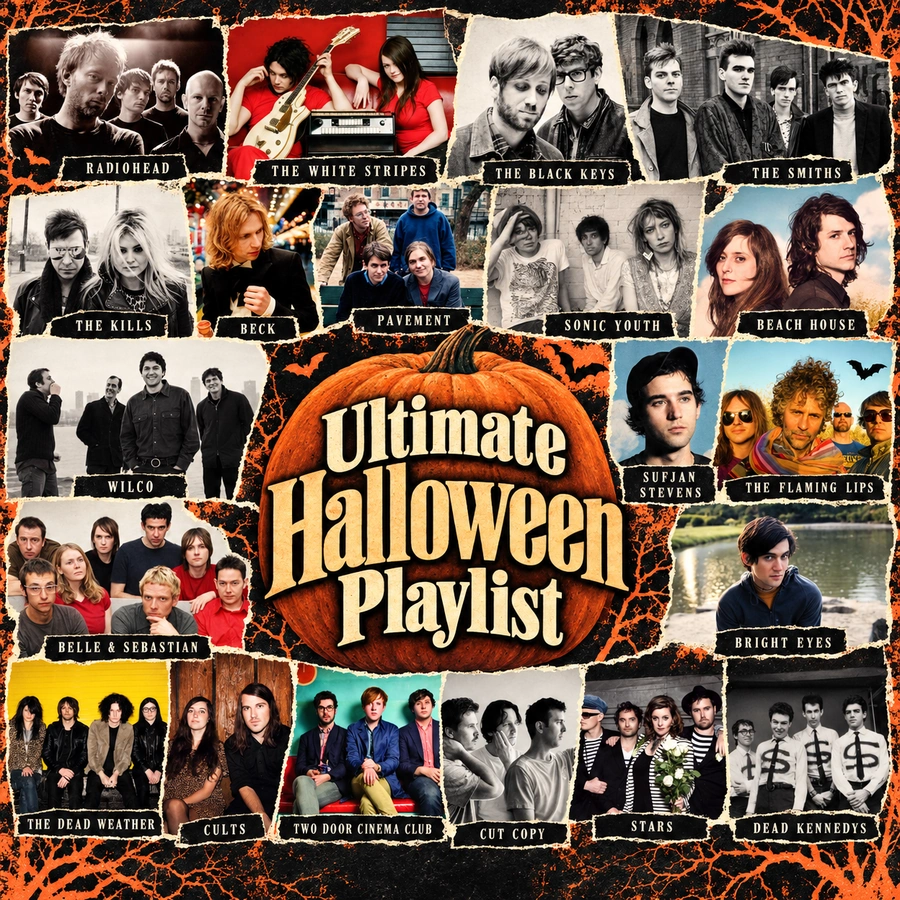
Happy Halloscream
Over the years, IRC has put together over a dozen different indie rock Halloween songs playlists, featuring hundreds of Halloween, or Halloweenish, songs.
Some songs were picked merely because the title is in some way, Halloweenish; you know, blood, ghosts, monsters, death, vampires, skeletons, darkness, and so on.
This is the ONLY Halloween Playlist Worth Streaming
NOTE: 50 has grown to almost 100! (udpated Oct 2026)
A Halloween indie rock playlist should have a few surprises lurking between the familiar faces. IRC’s Hallowscream collection finds them in garage-rock fables, gothic dance music and songs haunted by ordinary life. Radiohead, The Kinks, Sonic Youth and Band of Horses approach the darkness from different directions. Together, they supply enough atmosphere to carry October well past midnight.
Dance-Floor Dread: Radiohead and Yeah Yeah Yeahs
Radiohead open proceedings with “Burn the Witch” (2016), where the string arrangement turns nervous energy into a relentless pulse. Thom Yorke’s vocal floats above it with an uneasy composure. The menace comes from the crowd: suspicion gathering speed until everyone seems ready to join in. The video’s storybook setting conceals a thoroughly adult nightmare.
Then Yeah Yeah Yeahs’ “Heads Will Roll” (2009) kicks the doors open. The synth hook gleams, the beat demands movement, and Karen O treats the dance floor like her own gloriously unhinged kingdom. It brings theatrical excess to a collection that occasionally needs to loosen its collar.
The National’s “Afraid of Everyone” (2010) keeps the pulse but replaces the party with anxiety. Matt Berninger’s strained delivery makes the threat feel close and difficult to name. That uncertainty gives the playlist another kind of chill: the room looks perfectly normal, yet something feels wrong.
Garage-Rock Witches, Black Cats and Scarecrows
The Kinks’ “Wicked Annabella” (1968) supplies the crooked little fairy tale at the heart of this selection. Dave Davies sings about an outcast witch over a grimy guitar figure and heavy-footed drums. The track makes a village bedtime story sound dangerous, with enough fuzz around the edges to rough up its psychedelic setting.
The Black Keys bring a more mischievous swagger to “Howlin’ for You.” Its stomping rhythm feels built for a room full of costumes. Nearby, The Kills give “Cat Claw” a sharper bite. Alison Mosshart’s vocal and the abrasive guitar turn its feline title into something you can practically feel scratching at the furniture.
“Black Math” finds The White Stripes pushing their stripped-down machinery toward overload. It earns its place through sheer agitation: splintered guitar, pounding drums and barely contained energy.
Beck takes a stranger route on “Scarecrow” (2005). Its dusty groove and tangled imagery suggest a roadside apparition glimpsed through a dirty windshield. The rhythm stays inviting while the scenery gets increasingly peculiar. Halloween benefits from that balance; a little funk keeps the fog from settling too heavily.

The Slow Chill: Sonic Youth, The Cure and PJ Harvey
Sonic Youth’s “Halloween” (1985) works through suggestion. Kim Gordon’s hushed vocal moves among thin, uneasy guitar sounds, leaving plenty of room for the imagination to misbehave. The performance feels suspended, as though something has entered the room and nobody wants to turn around.
The Cure’s “Burn,” recorded for The Crow soundtrack in 1994, expands that tension into a gothic panorama. The insistent drums and circling guitar create forward motion, while Robert Smith’s voice carries the weight of grief. Its drama suits the season without losing the human ache beneath the shadows.
PJ Harvey’s “Down by the Water” (1995) draws closer still. The low electronic pulse feels ominously steady, and the whispered closing passage makes the song’s disturbing fable harder to shake. Harvey understands how much menace a controlled voice can hold. She leaves the listener leaning in when every sensible instinct says to step back.
These tracks give the playlist depth between its bigger hooks. Their power lies in pacing, texture and the uncomfortable space around a voice. Give them room to breathe; they do their best work when the conversation begins to fade.

Ghosts That Stay After the Party
Band of Horses make “Is There a Ghost” (2007) feel enormous with very little language. Ben Bridwell begins in a fragile hush before the guitars arrive in a bright, sweeping rush. The repeated question remains unanswered, caught between an actual haunting and the strange thoughts that flourish when sleep refuses to come.
Cat Power’s “Werewolf” brings a gentler kind of unease. Chan Marshall’s spare reading of Michael Hurley’s song gives the creature loneliness and vulnerability. Here, the monster seems capable of breaking your heart. The sparse arrangement lets each phrase hang in the air, so even its silences seem to be keeping someone company.
Sufjan Stevens offers a busier afterlife on “They Are Night Zombies!! They Are Neighbors!! They Have Come Back from the Dead!! Ahhhh!” From Illinois (2005), its bustling arrangement and chanted backing voices make forgotten history stir under the pavement. The absurdly long title promises a spectacle, and the music delivers one with a mournful undertow.
That range keeps this Halloween playlist alive beyond a single party. Its witches can dance, its ghosts can grieve, and its most unsettling moments arrive quietly. Start the stream at dusk and let the mood change with the light.
More from the IRC archive: Top 40 Indie & Alternative Halloween Songs, Vol. I · Halloween Songs: Dead Weather, Flaming Lips & More · Halloween Songs: The Finale
Some of The Kinks’ Early Halloweenish Songs
This mix also includes a trio of Halloweenish songs from The Kinks, dating back to their classic era (1966-1971) during which the band built a discography of amazing music that remains legendary to this day. In fact, as was the case with so many genres of music over the decades – including rock, punk, metal, new wave and pop – many of today’s indie bands are influenced by The Kinks, either directly or indirectly.
The three Halloweenish Kinks’ songs below demonstrate the band’s abilities to write about all kinds of topics, and record all types of different sounds and styles. The first track, “Wicked Annabella” is a creepy, sinister-sounding song with wicked vocals by Ray Davies and his younger brother and guitarist, Dave Davies. The song was first released way back in 1968 on The Kinks’ widely acclaimed masterpiece LP, The Village Green Preservation Society.
“Wicked Annabella“– The Kinks
The follow-up track, “Big Black Smoke,” is essentially a song about a young woman who grew tired of the country life, but her parents thought she couldn’t do any wrong, until she “walked the streets of the big, black smoke.”
In addition to the title – not so much the lyrics – the song has a kind of spooky, steady stomp, thick bass line and catchy chorus.
“Big Black Smoke“– The Kinks
The final song, “King Kong” is again menacing in the way “Wicked Annabella” is. There’s also something about the rawness of the recording itself. In fact, “Big Black Smoke” and “King Kong” were originally recorded on mono and only released on the klassic Kinks’ double-LP, The Kinks Kronikles.
“King Kong“ – The Kinks